

What Collaborative Care Should Actually Look Like Between Therapist and Psychiatrist

Ask a room of therapists about their experiences coordinating with psychiatrists and you will hear the same story in different keys: the referral disappears into a void, the medication list changes without warning, and the only update arrives months later — from the client, secondhand, half-remembered. “Collaborative care” is on every practice’s website. It is in very few clients’ charts.
Picture of AUTHOR

AUTHOR

Dr. Yusuf Modan

The frustrating part is that we know coordination works. This post lays out what the evidence shows, what real collaboration looks like in practice, and the questions worth asking any psychiatrist before you send them your clients.

The Evidence: Teams Beat Silos

The best-studied model is collaborative care for depression in primary care. In the IMPACT randomized trial — 1,801 patients across 18 clinics — team-based care, in which a psychiatrist, care manager, and treating clinician actually communicated about shared patients, produced a response rate of roughly 45% at twelve months. Usual care produced 19%.¹ Same patients, same medications available, same evidence base. The difference was the structure: someone owned the follow-up, and the clinicians talked to each other.
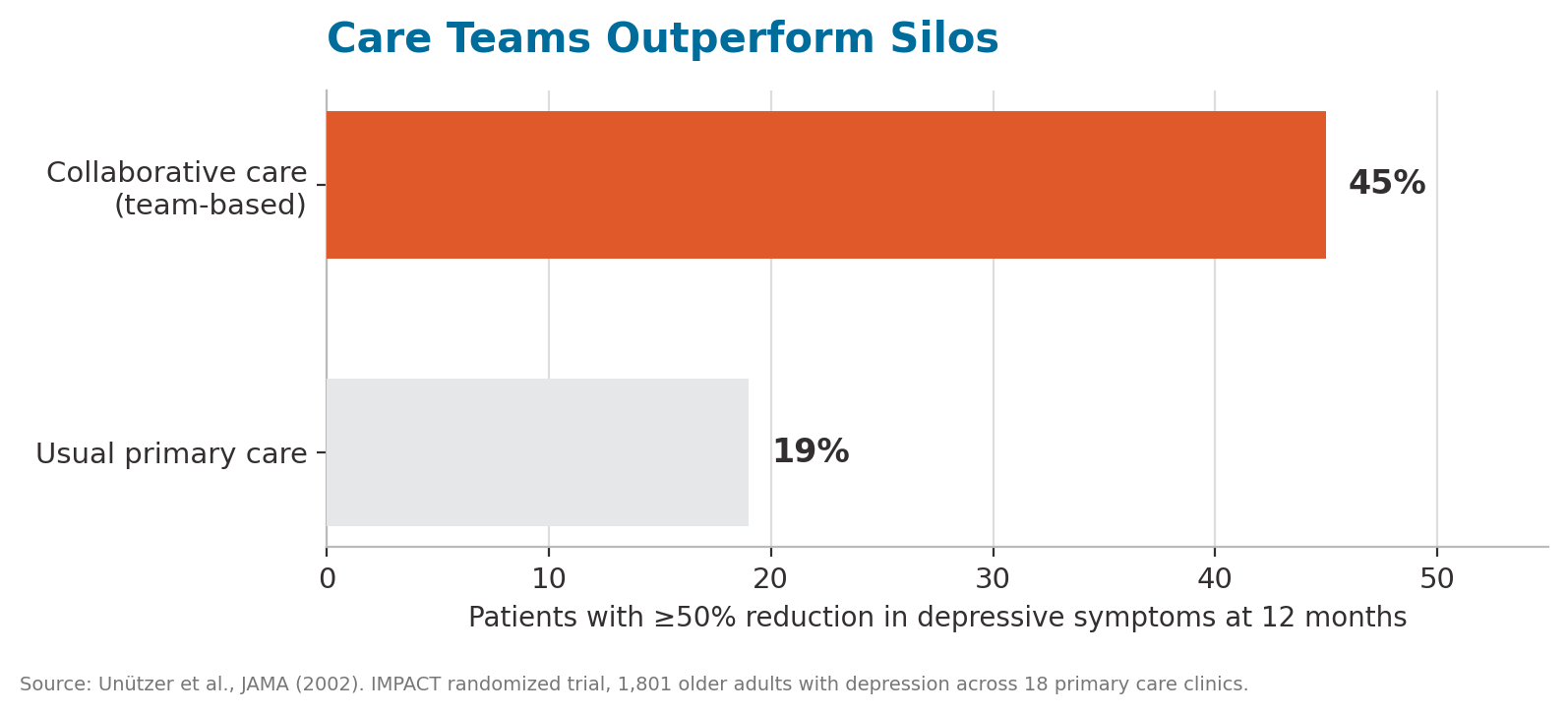
Therapy-psychiatry collaboration is a different setting, but the mechanism transfers: shared patients do better when their clinicians operate as a team rather than as two strangers who happen to bill the same person.

What Real Collaboration Looks Like

  • A closed loop after the first visit. With the client’s consent, you should hear that the appointment happened, what the working impression is, and what was started or changed. Silence after a referral is not neutrality; it is a coordination failure.
  • Medication changes you hear about from the psychiatrist, not the client. You are watching the client weekly. If a dose changed, you are the early-warning system for both benefit and side effects — but only if you know.
  • A reachable human. When you observe something concerning — activation, sedation, a mood shift — you need a channel that answers within a day or two, not a portal message into the dark.
  • Respect for role boundaries in both directions. The psychiatrist does not restructure the therapy; you do not adjust the medication. Each of you knows what the other is doing and why.

Questions to Ask Before You Refer

“After my client’s first appointment, what will I receive from you, and when? If I notice a concerning change between their visits, how do I reach you — and how fast do you respond?”

— The two questions that separate real collaborators from websites that say “collaborative”

A psychiatrist who welcomes those questions is one you can work with. A practice that cannot answer them concretely is telling you, politely, that you will be coordinating by carrier pigeon. Given that only 18.5% of psychiatrists are reachable and available for new patients in the first place,² it is worth being selective about the ones who are.

How Ascent Closes the Loop

Collaboration is built into Ascent’s model rather than bolted on. Every referred client has a dedicated Care Navigator who knows who referred them and keeps that channel open. With the client’s consent, you receive an update after the first visit — they were seen, here is the plan, here is how to reach us — and you hear about medication changes from us, not from your client’s best recollection. Dr. Modan’s appointments are longer by design, which means there is time to actually read what you send and incorporate it. Your client stays your client. We are the medication arm of a team you are already leading.

Referring Is Simple

Have your client call (215) 876-5015 or email info@ascent-psychiatry.com and mention your name. Their Care Navigator takes it from there. If you would like to talk with Dr. Modan first — about a specific client or just to know who you are referring to — we are glad to set up a brief introduction call.


Integrative Psychiatric Care at Ascent Psychiatry

Dr. Modan takes a whole-person approach, combining evidence-based psychiatry with informed discussion of nutritional and integrative options. Schedule a consultation to discuss your care.

About Ascent

Ascent Psychiatry is a concierge, virtual psychiatry practice based in Pennsylvania. We serve adults, children, and adolescents. Led by Dr. Yusuf Modan — with over 20 years of experience and advanced training — Ascent offers longer appointments, same-week availability, and a level of personal attention you won’t find in a traditional practice.

We treat a wide range of conditions including anxiety, depression, ADHD, bipolar disorder, PTSD, OCD, eating disorders, and more. If you’re looking for compassionate, unhurried psychiatric care from the comfort of your own home, we’d love to hear from you.

Let's Get Started.

Trying to reach us via email?

Trying to reach us by phone?

Want to book an appointment?

Trying to reach your Care Navigator?

Care Navigators will generally reply the same or next business day.

Trying to reach your doctor?

Dr. Yusuf Modan

Your doctor may take 2-3 business days to reply. If you need something more urgently, please reach out to your Care Navigator or call our office at TBD.

Trying to share feedback?

We want to hear your feedback. This will be kept anonymous, confidential and will not affect your care.